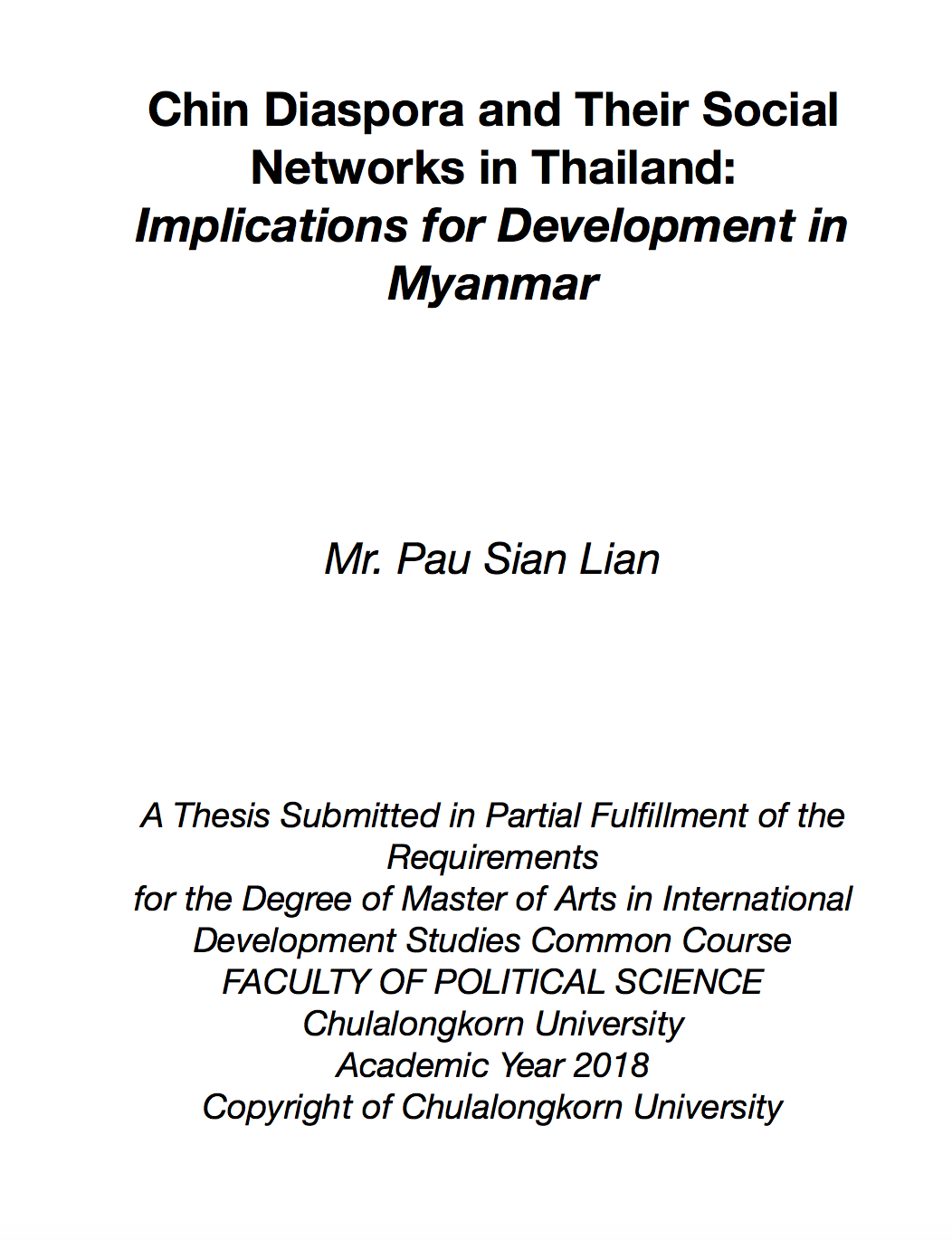
Chin Diaspora and Their Social Networks in Thailand: Implications for Development in Myanmar

Categories: , ,

Description

Summary — Chin Diaspora and Their Social Networks in Thailand: Implications for Development in Myanmar

Pau Sian Lian, Master of Arts, Chulalongkorn University (2018)

This master’s thesis examines the Chin diaspora in Thailand, focusing on their characteristics, social networks, and contributions to economic and political development in Myanmar.

Using both qualitative and quantitative research methods—including fieldwork in Bangkok, Bang Pa-In, and Mahachai—the study applies Safran’s (1991) concept of diaspora and Weber’s (2014) theory of migrant social networks to analyze the Chin community in Thailand .

Key Findings

  1. Characteristics of the Chin Diaspora
    The study finds that most Chin migrants came to Thailand at a young age, often leaving school early due to poverty and limited opportunities in Myanmar . Many work in low-skilled sectors such as factories, domestic work, and restaurants, earning around Thailand’s minimum wage .

Despite living abroad, they maintain a strong emotional and cultural attachment to Chin State. The research concludes that the Chin diaspora in Thailand meets the six key features of diaspora identified by Safran (1991), including collective memory, sense of belonging, and belief in eventual restoration of their homeland .

  1. Social Networks
    Chin social networks in Thailand evolved from informal and limited connections before 2007 to more organized, fellowship-based structures afterward . Churches and sub-ethnic fellowships play a central role in community organization.

Strong ties exist within sub-ethnic groups, while broader intra-Chin networks are weaker . Technology—especially mobile phones and social media—has strengthened transnational connections between Chin migrants and their families in Myanmar .

  1. Economic and Political Implications for Myanmar
    The thesis finds that Chin migrants make a moderate economic contributionto their home communities through remittances and knowledge sharing . However, remittances are often sent through informal channels and primarily support household needs rather than long-term investments .

Political participation from abroad is limited. The study concludes that the Chin diaspora’s political contribution to Myanmar is relatively weak, partly due to livelihood pressures and limited facilitation from Myanmar authorities in Thailand .

  1. Future Aspirations
    Although many respondents express a desire to return to Myanmar someday, voluntary repatriation is unlikely in the near future due to wage differences and limited economic opportunities in Chin State .

Overall Conclusion

The thesis concludes that the Chin diaspora in Thailand maintains strong social and emotional ties to their homeland and contributes moderately to economic development in Myanmar, but their political engagement remains limited .

The research provides valuable insight into transnational Chin networks and offers policy implications for both Myanmar and Thailand regarding migrant engagement and diaspora development.

Additional information

Author

Format

Language

Year Published

Reviews

There are no reviews yet.

Be the first to review “Chin Diaspora and Their Social Networks in Thailand: Implications for Development in Myanmar”